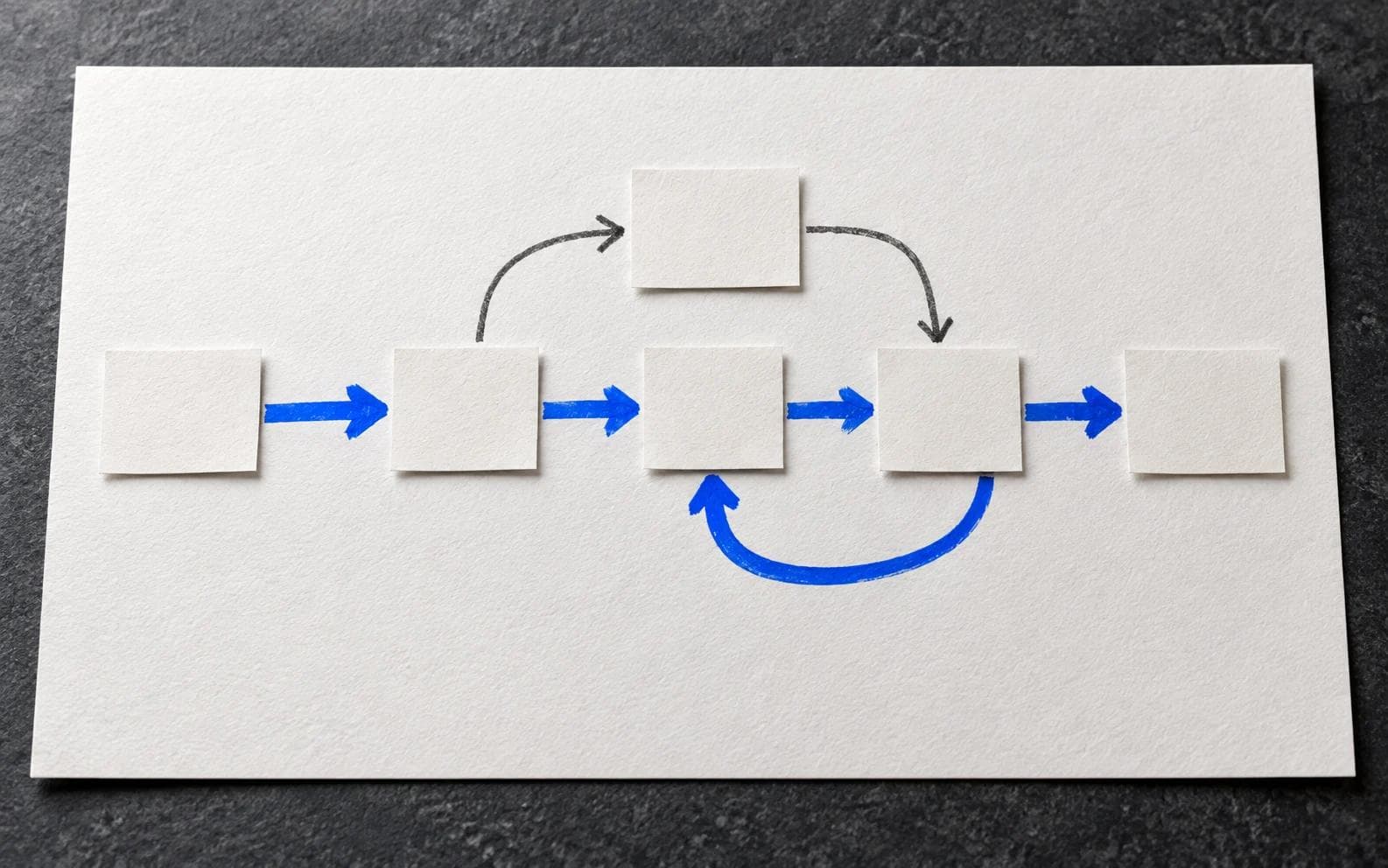

Lost time does not always arrive as a dramatic failure. It can be the same number copied into three systems, the search for the latest document or a question asked again because the answer lives in someone's inbox. Each interruption looks small. Together they can make a normal working day unnecessarily difficult.
Look for repeated friction
For one week, ask a small group to record moments when work stops or repeats. Keep the exercise light: what were you trying to do, what got in the way and roughly how long did it take? Explain the purpose clearly. You are examining the workflow, not ranking people's speed.
Useful categories include re-entering information, finding information, waiting for a decision, correcting incomplete requests and checking whether something has already happened. Give each entry enough context to explain the cause. 'Admin' is too broad to improve.
Count occurrences as well as minutes
A hypothetical team might spend four minutes copying each completed job into an invoicing sheet. At 60 jobs a week, that is 240 minutes, or four hours of task time. That calculation tells you where to investigate; it does not prove an integration will recover all four hours.
Include review time, unusual cases and the time required to maintain any replacement process. Distinguish time spent actively working from time elapsed while an item waits. Reducing a customer's wait may matter even if the team spends the same number of minutes on the task.
Find the repeated cause
Ask why the information is copied. Is the invoicing system missing a required field? Is the job record unreliable? Does someone need to approve the amount first? Automating the copy before answering those questions may simply move an error faster.
Look at the point where information first enters the workflow. A consistent reference number, a clear owner and a shared definition of 'ready' can prevent several later checks. Fixing a handoff is often a sensible first experiment.
Choose one small improvement
Rank opportunities by frequency, business consequence and how easy they are to change safely. Start with an issue that happens regularly and has a clear owner. Agree what you will measure and what would make you reverse the change.
After the trial, ask the team whether the friction disappeared or moved somewhere else. Compare similar volumes and include exceptions. A shorter spreadsheet is not evidence of a better workflow if someone now does the missing work in email.
Use a realistic cost calculation when the decision requires investment. Treat the result as an estimate with assumptions, then replace those assumptions with observations as the pilot runs.