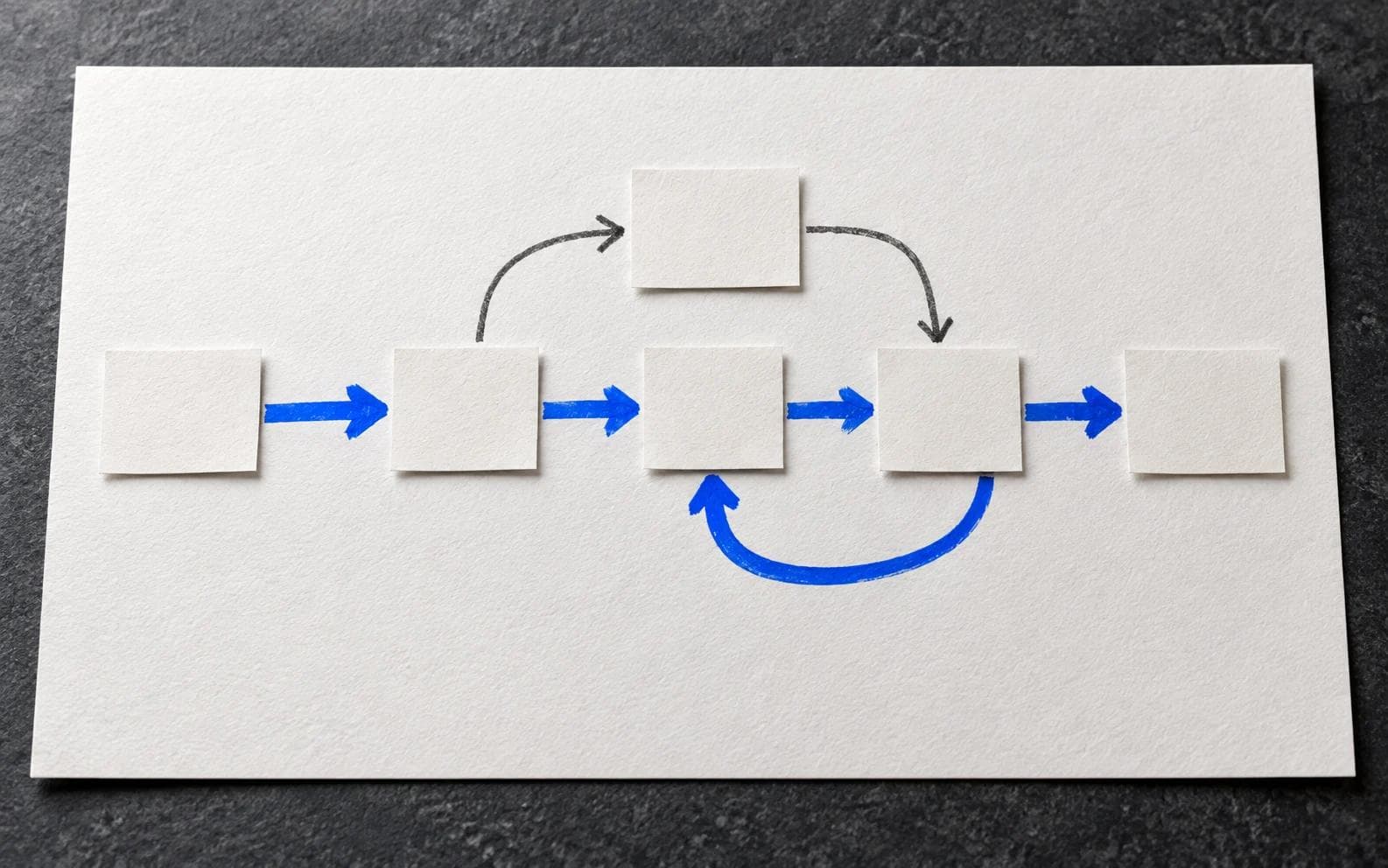

A repeated task is a reason to investigate, not an automatic reason to automate. Some tasks are unnecessary. Some are useful but badly organised. Some happen so rarely that building and maintaining an automation would create more work than it removes.
First ask whether the task should exist
What useful outcome does it produce? Who uses the result? What would happen if it stopped? A report that nobody reads may need to disappear. A duplicate approval may need a clearer decision rule. Removing unnecessary work is usually simpler than maintaining a faster version of it.
Automate a stable, valuable step
Automation is a promising option when the inputs are available, the rules are clear, the task repeats and exceptions can be handled. Examples might include transferring an approved order into another system or sending a reminder when a known date approaches.
Define success and failure before implementation. Where will errors appear? Who checks them? How will you avoid processing the same item twice? What manual route remains available? The normal path is only part of a usable automation.
Replace when the underlying system is the obstacle
A hypothetical business could have several automations surrounding a spreadsheet because it cannot control access, reliably identify records or show current status. Another script might relieve one symptom. Moving the workflow into an appropriate existing application could address the underlying constraints.
Replacement has costs too: migration, training, integration, support and disruption. Compare those costs with extending the current approach. Do not assume custom software is the default; compare off-the-shelf and custom options against the work they need to support.
Leave it alone when the change is not worthwhile
A low-volume task requiring careful judgement may be fine as a documented manual process. Leaving it alone can still mean improving the checklist, naming an owner or making the source information easier to find.
Estimate the annual effort involved, but avoid presenting every hour as cash that can be removed from the budget. Freed capacity only has value if the business can use it. Reliability, customer experience and risk may matter more than minutes.
Try the smallest credible change
Write down the options: remove, simplify, automate, replace or keep. For each, describe the outcome, costs, exceptions and ongoing owner. Choose a pilot that can test the important assumption before committing to a larger build.
Start with a workflow map, then decide how you will measure improvement. A good decision is one you can explain in terms of the work and its result, rather than the appeal of a tool.